Technical details
All variables are static in memory
All variables are allocated statically, there is no concept of dynamic heap or stack frames. Essentially all variables are global (but scoped) and can be accessed and modified anywhere, but care should be taken of course to avoid unexpected side effects.
Especially when you’re dealing with interrupts or re-entrant routines: don’t modify variables that you not own or else you will break stuff.
Variables that are not put into zeropage, will be put into a special ‘BSS’ section for the assembler. This section is usually placed at the end of the resulting program but because it only contains empty space it won’t actually increase the size of the resulting program binary. Prog8 takes care of properly filling this memory area with zeros at program startup and then reinitializes the subset of variables that have a nonzero initialization value.
Arrays with initialization values are not put into BSS but just occupy a sequence of bytes in the program memory: their values are not reinitialized at program start.
It is possible to relocate the BSS section using a compiler option so that more system ram is available for the program code itself.
ROM/RAM bank selection
On certain systems prog8 provides support for managing the ROM or RAM banks that are active.
system |
get banks (returns byte) |
set banks |
|---|---|---|
c64 |
|
|
c128 |
|
|
cx16 |
|
|
other |
N/A |
N/A |
Calling a subroutine in another memory bank can be done by using the callfar or callfar2 builtin functions.
When you are using the routines above, you are doing explicit manual banks control. However, Prog8 also provides something more sophisticated than this, when dealing with banked subroutines:
External subroutines defined with extsub can have a non-standard ROM or RAM bank specified as well.
The compiler will then transparently change a call to this routine so that the correct bank is activated
automatically before the normal jump to the subroutine (and switched back on return). The programmer doesn’t
have to bother anymore with setting/resetting the banks manually, or having the program crash because
the routine is called in the wrong bank! You define such a routine by adding @bank <bank>
to the extsub subroutine definition. This specifies the bank number where the subroutine is located in.
You can use a constant bank number 0-255, or a ubyte variable to make it dynamic:
extsub @bank 10  $C09F = audio_init()
extsub @bank banknr  $A000 = first_hiram_routine()
When you then call this routine in your program as usual, the compiler will no longer generate a simple JSR instruction to the routine. Instead it will generate a piece of code that automatically switches the ROM or RAM bank to the correct value, does the call, and switches the bank back. The exact code will be different for different compilation targets, and not all targets even have banking or support this. As an example, on the Commander X16, prog8 will use the JSRFAR kernal routine for this. On the Commodore 128, a similar call exists (but requires a lot more code to prepare, so beware). On the Commodore 64 some custom code is also emitted that toggle the banks, retains some registers, and does the call. Other compilation targets don’t have banking or prog8 doesn’t yet support automatic bank selection on them.
There’s a “banking” example for the Commander X16 that shows a possible application of the extsub with bank support, check out the bank example code .
Notice that the symbol for this routine in the assembly source code will still be defined as usual. The bank number is not translated into assembly (only as a comment):
p8s_audio_init = $c09f ; @bank 10
Caution
Calls with automatic bank switching like this are not safe to use from IRQ handlers. Don’t use them there. Instead change banks in a controlled manual way (or not at all).
Note
On the C64 and C128, the Basic ROM is banked out by default when running a Prog8 program, because
it is not needed. This means on the C64 we get access to another 8Kb of RAM at that
memory area, which actually gives us a 50 Kb contiguous RAM block from $0801 to $d000 (exclusive).
This means you can create programs of up to 50 Kb size with prog8 on the C64.
On the C128, it means programs can use ~41 Kb of contiguous RAM at $1c00 to $c000 (exclusive).
However, if your program uses floats, Prog8 does need the Basic ROM for the floating point routines,
and it won’t be banked out. Such programs are limited to the regular size of about 38 Kb on the C64, and less on the C128.
Be aware that the bank setting is only done if you are not using %option no_sysinit because the
program’s bootstrap code is what initializes the memory bank configuration.
Symbol prefixing in generated Assembly code
All symbols in the prog8 program will be prefixed in the generated assembly code:
Element type |
prefix |
|---|---|
Block |
|
Subroutine |
|
Variable |
|
Constant |
|
Label |
|
Struct |
|
Struct Field |
|
Enum Member |
|
other |
|
This is to avoid naming conflicts with CPU registers, assembly instructions, etc.
So if you’re referencing symbols from the prog8 program in inlined assembly code, you have to take
this into account. Stick the proper prefix in front of every symbol name component that you want to reference that is coming
from a prog8 source file.
All elements in scoped names such as main.routine.var1 are prefixed so this becomes p8b_main.p8s_routine.p8v_var1.
Attention
Symbols from library modules are not prefixed and can be used in assembly code as-is. So you can write:
%asm {{
    lda  #'a'
    jsr  cbm.CHROUT
}}
Subroutine Calling Conventions
Calling a subroutine requires three steps:
preparing the arguments (if any) and passing them to the routine. Numeric types are passed by value (bytes, words, longs, booleans, floats), but array types passed by reference which means as
uwordbeing a pointer to their address in memory. Strings are passed as a pointer to a byte:^^ubyte.calling the subroutine
preparing the return value (if any) and returning that from the call.
There is no stack handling involved: Prog8 doesn’t have call stack frames.
Regular subroutines
Each subroutine parameter is represented as a variable scoped to the subroutine. Prog8 doesn’t have a call stack.
The arguments passed in a subroutine call are evaluated by the caller, and then put into those variables by the caller. The order of evaluation of subroutine call arguments is unspecified and should not be relied upon.
The subroutine is invoked.
The return value is not put into a variable, but the subroutine passes it back to the caller via register(s). See below.
Single arguments will often be passed in registers:
For single byte, word, and pointer arguments (not long or float), the values are simply loaded in cpu registers by the caller before calling the subroutine. The subroutine itself will take care of putting the values into the parameter variables. This saves on code size because otherwise all callers would have to store the values in those variables themselves. Note that this convention is also still used for subroutines that specify parameters to be put into one of the virtual registers R0-R15, as those are in the end just variables too (see Reusing virtual registers R0-R15 for parameters) The rules are as follows:
- Single byte parameter:
sub foo(ubyte bar) { ... } gets bar in the accumulator A, subroutine stores it into parameter variable
- Two byte parameters:
sub foo(ubyte bar, ubyte baz) { ... } gets bar in the accumulator A, and baz in Y, subroutine stores it into parameter variable
- Single word parameter:
sub foo(uword bar) { ... } gets bar in the register pair A + Y (lsb in A, msb in Y), subroutine stores it into parameter variable
- Single pointer parameter:
sub foo(^^ubyte bar) { ... } gets bar in the register pair A + Y (lsb in A, msb in Y), subroutine stores it into parameter variable
- Long or Floating point parameter:
sub foo(long bar) { ... },sub foo(float bar) { ... } value for bar gets stored into the parameter variable by the caller
- Other:
sub foo(ubyte bar, ubyte baz, ubyte zoo) { ... } not using registers; all values get stored in the subroutine’s parameter variables by the caller
Return value
A byte return value will be put in
A.A boolean return value will be put in
Atoo, as 0 or 1.A word return or pointer value will be put in
A+Yregister pair (lsb in A, msb in Y).A long return value will be put into
cx16.r14andcx16.r15(2 word virtual registers, low word and high word, to make up a single 32 bits long)A float return value will be put in the
FAC1float ‘register’.
In case of multiple return values:
for an
asmsuborextsubthe subroutine’s signature specifies the output registers that contain the values explicitly, just as for a single return value.for regular subroutines, the compiler will return the first of the return values via the cpu register
A`(orA + Y`if it’s a word value), just like for subroutines that only return a single value. The remainder of the return values are returned via the “virtual registers” cx16.r16-cx16.r0 (using R15 first and counting down to R0). Long values will take a pair of those “virtual registers” that combined make up a single 32 bits value. A floating point value is passed via FAC1. Multiple float return values are supported on the virtual target, but limited to a single float on 6502 targets (because the ROM float routines use FAC1/FAC2 as operand registers which would clobber earlier return values).
asmsub and extsub routines
These are kernal (ROM) routines or low-level assembly routines, that get their arguments via specific registers.
Sometimes even via a processor status flag such as the Carry flag.
Note that word values can be put in a “CPU register pair” such as AY (meaning A+Y registers) but also
in one of the 16 ‘virtual’ 16 bit registers introduced by the Commander X16, R0-R15.
Float values can be put in the FAC1 or FAC2 floating point ‘registers’.
The return values also get returned via designated registers, or via processor status flags again.
This means that after calling such a routine you can immediately act on the status
via a special branch instruction such as if_z or if_cs etc.
The register/status flag usage is fully specified in the asmsub or extsub signature definition
for both the parameters and the return values:
extsub $2000 = extfunction(ubyte arg1 @A, uword arg2 @XY, uword arg3 @R0,
                           float frac @FAC1, bool flag @Pc) -> ubyte @Y, bool @Pz

asmsub function(ubyte arg1 @A, uword arg2 @XY, uword arg3 @R0,
                float frac @FAC1, bool flag @Pc) -> ubyte @Y, bool @Pz {
    %asm {{
        ...
        ...
    }}
}
Compiler Internals
Here is a diagram of how the compiler translates your program source code into a binary program:
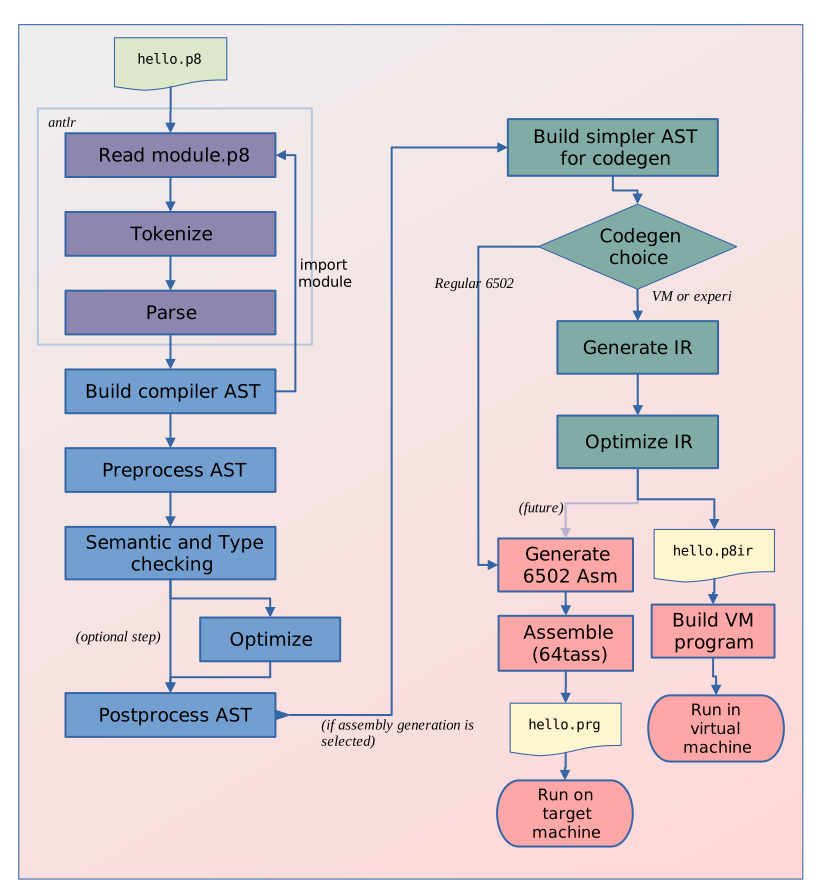
Some notes and references into the compiler’s source code modules:
The
compileProgram()function (in thecompilermodule) does all the coordination and basically drives all of the flow shown in the diagram.ANTLR is a Java parser generator and is used for initial parsing of the source code. (
parsermodule)Most of the compiler and the optimizer operate on the Compiler AST. These are complicated syntax nodes closely representing the Prog8 program structure. (
compilerAstmodule)For code generation, a much simpler AST has been defined that replaces the Compiler AST. Most notably, node type information is now baked in. (
codeCoremodule, Pt- classes)An Intermediate Representation has been defined that is generated from the simplified AST. This IR is more or less a machine code language for a virtual machine - and indeed this is what the built-in prog8 VM will execute if you use the ‘virtual’ compilation target and use
-emuto launch the VM. (intermediateandcodeGenIntermediatemodules, andvirtualmachinemodule for the VM related stuff) Note that this IR is still targeted to one specific compilation target only; various properties and all library code for the selected target machine is encoded into the IR. It is not possible to eventually create a C64 program from an IR file created for the CommanderX16 target.The code generator backends all implement a common interface
ICodeGeneratorBackenddefined in thecodeCoremodule. Currently they get handed the program Ast, Symboltable and several other things. If the code generator wants it can use theIRCodeGenclass from thecodeGenIntermediatemodule to convert the Ast into IR first. The VM target uses this, but the 6502 codegen doesn’t right now.
ROM-able programs
Normally Prog8 will use some tricks to generate the smallest and most optimized code it can. This includes the following techniques that by default prevent generated program code from running in ROM:
- self-modifying code
This is program code that actually modifies itself during program execution (instructions or operands are modified) When the program is in ROM, such modifications are impossible, so the program will not execute correctly.
- inline variables
These are variables that are located in the same memory region that the program code is in (or even interleaved within the program code). Again, writing to such variables will not work when it is in ROM, so the program will not execute correctly.
(Not all prog8 source code will end up using these techniques but you should not depend on it.)
The directive %option romable changes this behavior.
It tells the compiler to no longer generate code using these two tricks, and instead revert to slightly slower running code (or needing more instructions)
but which is able to run from ROM.
There are a few things to note:
string variables and array variables that are initialized with something other than just zeros, are no longer mutable. This is because both of these will still end up as part of the same memory region the program code is in (which will be ROM). The compiler will try to detect writes to them and give an error if these occur. However it cannot detect all such writes, so beware.
arrays without an initialization literal will be placed into the memory region for variables instead which can and should be placed in RAM, so those arrays are mutable as usual.
the same holds for memory blocks allocated using the
memoryfunction; nothing changes for them.the memory region for variables and memory blocks (BSS sections) should be explicitly placed in RAM memory. You can do this with the
-varsgoldenor-varshigh, and-slabsgoldenor-slabshighcommand line options. Maybe in the future an option will be added to choose a memory address for those manually.
Note
The ROMable code generation is still quite experimental. Problems may still surface, and perhaps stuff will change a bit in a future compiler version.
Formal ANTLR4 syntax and grammar definition
/*
Prog8 combined lexer and parser grammar

NOTES:

- whitespace is ignored. (tabs/spaces)
- every position can be empty, be a comment, or contain ONE statement.

*/

// -> java classes Prog8ANTLRParser and Prog8ANTLRLexer,
// both NOT to be used from Kotlin code, but ONLY through Kotlin class Prog8Parser
grammar Prog8ANTLR;

@header {
package prog8.parser;
}

EOL :  ('\r'? '\n' | '\r' | '\n')+ ;
LINECOMMENT : EOL [ \t]* COMMENT -> channel(HIDDEN);
COMMENT :  ';' ~[\r\n]* -> channel(HIDDEN) ;
BLOCK_COMMENT : '/*' ( BLOCK_COMMENT | ~'*' | '*' ~'/' )*? '*/' -> skip ;

WS :  [ \t] -> skip ;
// WS2 : '\\' EOL -> skip;
VOID: 'void';
STRUCT: 'struct';
ON: 'on';
GOTO: 'goto';
CALL: 'call';
INLINE: 'inline';
PRIVATE: 'private';
STEP: 'step';
ELSE: 'else';
THEN: 'then';
ENUM: 'enum';

UNICODEDNAME :  [\p{Letter}]([\p{Letter}\p{Mark}\p{Digit}_] | '::')* ;           // match unicode properties
UNDERSCORENAME :  '_' UNICODEDNAME ;           // match unicode properties
DEC_INTEGER :  DEC_DIGIT (DEC_DIGIT | '_')* ;
HEX_INTEGER :  '$' HEX_DIGIT (HEX_DIGIT | '_')* ;
BIN_INTEGER :  '%' BIN_DIGIT (BIN_DIGIT | '_')* ;
ADDRESS_OF: '&' ;
TYPED_ADDRESS_OF: '&&' ;
ADDRESS_OF_MSB: '&>' ;
ADDRESS_OF_LSB: '&<' ;
POINTER: '^^';

fragment HEX_DIGIT: ('a'..'f') | ('A'..'F') | ('0'..'9') ;
fragment BIN_DIGIT: ('0' | '1') ;
fragment DEC_DIGIT: ('0'..'9') ;

FLOAT_NUMBER : DEC_DIGIT (DEC_DIGIT | '_')* ('.' (DEC_DIGIT | '_')*)? (('E'|'e') ('+'|'-')? DEC_INTEGER)?
             | '.' (DEC_DIGIT | '_')+ (('E'|'e') ('+'|'-')? DEC_INTEGER)?
             ;

STRING_ESCAPE_SEQ :  '\\' [\u0021-\u007E] | '\\x' HEX_DIGIT HEX_DIGIT | '\\u' HEX_DIGIT HEX_DIGIT HEX_DIGIT HEX_DIGIT;
STRING :
    '"' ( STRING_ESCAPE_SEQ | ~[\\\r\n\f"] )* '"'
    ;
INLINEASMBLOCK :
    '{{' .+? '}}'
    ;

SINGLECHAR :
    '\'' ( STRING_ESCAPE_SEQ | ~[\\\r\n\f'] ) '\''
    ;

TAG: '@' ('a'..'z' | '0'..'9')+ ;

EMPTYARRAYSIG : '[' [ \t]* ']' ;

NOT_IN: 'not' [ \t]+ 'in' [ \t] ;


// A module (file) consists of zero or more directives or blocks, in any order.
// If there are more than one, then they must be separated by EOL (one or more newlines).
// However, trailing EOL is NOT required.
// Note: the parser may see *several* consecutive EOLs - this happens when EOL and comments are interleaved (see #47)
module: EOL* (module_element (EOL+ module_element)*)? EOL* EOF;

module_element:
    directive | block ;


block: identifier integerliteral? EOL? '{' EOL? (block_statement | EOL)* '}';

// Note: enum and alias appear in both block_statement and statement rules.
// This is intentional - they are declaration statements like variabledeclaration,
// and can appear at block level or inside subroutines (local enums/aliases).
block_statement:
    directive
    | variabledeclaration
    | structdeclaration
    | subroutinedeclaration
    | inlineasm
    | labeldef
    | alias
    | enum
    ;


statement :
    directive
    | ongoto
    | variabledeclaration
    | structdeclaration
    | assignment
    | augassignment
    | unconditionaljump
    | postincrdecr
    | functioncall_stmt
    | if_stmt
    | branch_stmt
    | subroutinedeclaration
    | inlineasm
    | returnstmt
    | forloop
    | whileloop
    | untilloop
    | repeatloop
    | unrollloop
    | whenstmt
    | breakstmt
    | continuestmt
    | labeldef
    | defer
    | alias
    | enum
    | swap
    // Error recovery: match tokens that can NEVER start a valid expression
    | 'if' '{'
      { notifyErrorListeners("Missing condition: expected expression after 'if'"); }
    | 'while' '{'
      { notifyErrorListeners("Missing condition: expected expression after 'while'"); }
    | 'for' identifier 'in' '}'
      { notifyErrorListeners("Missing range: expected expression after 'in'"); }
    | 'for' identifier 'in' ('else' | 'return' | 'break' | 'continue' | 'defer' | '}')
      { notifyErrorListeners("Missing range: expected expression after 'in'"); }
    | 'return' ('}' | 'else' | 'while' | 'for' | 'if' | 'defer')
      { notifyErrorListeners("Invalid token after 'return'"); }
    | 'defer' ('}' | 'else' | 'while' | 'for' | 'if' | 'return' | 'break' | 'continue')
      { notifyErrorListeners("Expected statement after 'defer'"); }
    | 'when' '{'
      { notifyErrorListeners("Missing expression: expected condition after 'when'"); }
    | ENUM '{'
      { notifyErrorListeners("Expected enum name after 'enum'"); }
    | STRUCT '{'
      { notifyErrorListeners("Expected struct name after 'struct'"); }
    | ON (GOTO | CALL)
      { notifyErrorListeners("Missing expression: expected index after 'on'"); }
    ;


enum :  PRIVATE? ENUM identifier '{' EOL? enum_member? (',' EOL? enum_member)* ','? EOL? '}' ;       // you can split the values over several lines, trailing comma allowed

enum_member :  identifier ('=' integerliteral)?  ;

swap: 'swap' '(' assign_target ',' assign_target ')' ;


variabledeclaration :
    varinitializer
    | vardecl
    | constdecl
    | memoryvardecl
    ;


structdeclaration:
    PRIVATE? STRUCT identifier '{' EOL? (structfielddecl | EOL)+ '}'
    ;

structfielddecl: datatype identifierlist;


subroutinedeclaration :
    subroutine
    | asmsubroutine
    | extsubroutine
    ;

alias: PRIVATE? 'alias' identifier '=' scoped_identifier ;

defer: 'defer' (statement | statement_block) ;

labeldef :  identifier ':'  ;

unconditionaljump :  GOTO  expression ;

directive : directivename '!'? (directivenamelist | (directivearg? | directivearg (',' directivearg)*))   ;

directivename: '%' UNICODEDNAME;

directivenamelist: '(' EOL? scoped_identifier (',' EOL? scoped_identifier)* ','? EOL?')' ;

directivearg : stringliteral | identifier | integerliteral ;

vardecl: PRIVATE? datatype (arrayindex arrayindex? | EMPTYARRAYSIG)? TAG* identifierlist ;

identifierlist: identifier (',' identifier)* ;

varinitializer :
    vardecl '=' expression
    | vardecl '=' tuple_expression
    ;

constdecl: PRIVATE? 'const' datatype? identifierlist '=' expression ;

memoryvardecl: ADDRESS_OF varinitializer;

basedatatype:  'ubyte' | 'byte' | 'uword' | 'word' | 'long' | 'float' | 'str' | 'bool' ;

datatype: pointertype | basedatatype | structtype=scoped_identifier;

pointertype: POINTER (scoped_identifier | basedatatype);

arrayindex:  '[' expression ']' ;

assignment :
    assign_target '=' expression
    | assign_target '=' assignment
    | multi_assign_target '=' expression
    | multi_assign_target '=' tuple_expression
    ;

augassignment :
    assign_target operator=('+=' | '-=' | '/=' | '*=' | '&=' | '|=' | '^=' | '%=' | '<<=' | '>>=' ) expression
    ;

// Note: VOID can be used in multiple ways but a semantic AST check takes care of any mistakes there later.
assign_target:
    scoped_identifier               #IdentifierTarget
    | arrayindexed                  #ArrayindexedTarget
    | directmemory                  #MemoryTarget
    | pointerdereference            #PointerDereferenceTarget
    | VOID                          #VoidTarget
    ;


multi_assign_target:
    assign_target (',' assign_target)+ ;

postincrdecr :  assign_target  operator = ('++' | '--') ;

expression :
    '(' expression ')'
    | sizeof_expression = 'sizeof' '(' sizeof_argument ')'
    | functioncall
    | left = expression EOL? bop = '.' EOL? right = expression          // "scope traversal operator"
    | <assoc=right> prefix = ('+'|'-'|'~') expression
    | left = expression EOL? bop = ('*' | '/' | '%' ) EOL? right = expression
    | left = expression EOL? bop = ('+' | '-' ) EOL? right = expression
    | left = expression EOL? bop = ('<<' | '>>' ) EOL? right = expression
    | left = expression EOL? bop = '&' EOL? right = expression
    | left = expression EOL? bop = '^' EOL? right = expression
    | left = expression EOL? bop = '|' EOL? right = expression
    | left = expression EOL? bop = ('<' | '>' | '<=' | '>=') EOL? right = expression
    | left = expression EOL? bop = ('==' | '!=') EOL? right = expression
    | rangefrom = expression rto = ('to'|'downto') rangeto = expression (STEP rangestep = expression)?    // can't create separate rule due to mutual left-recursion
    | left = expression EOL? bop = 'in' EOL? right = expression
    | left = expression EOL? bop = NOT_IN EOL? right = expression
    | prefix = 'not' expression
    | left = expression EOL? bop = 'and' EOL? right = expression
    | left = expression EOL? bop = 'or' EOL? right = expression
    | left = expression EOL? bop = 'xor' EOL? right = expression
    | literalvalue
    | scoped_identifier
    | arrayindexed
    | directmemory
    | addressof
    | expression typecast
    | if_expression
    | branchcondition_expression
    | pointerdereference
    | staticstructinitializer
    ;

tuple_expression: expression (',' EOL? expression)+  ;

sizeof_argument: basedatatype | scoped_identifier | pointertype | addressof ;


arrayindexed:
    scoped_identifier arrayindex+
    ;


typecast : 'as' datatype;

directmemory : '@' '(' expression ')';

addressof : <assoc=right> (ADDRESS_OF | TYPED_ADDRESS_OF | ADDRESS_OF_LSB | ADDRESS_OF_MSB) scoped_identifier arrayindex? ;

functioncall : scoped_identifier '(' EOL? expression_list? EOL? ')'  ;

functioncall_stmt : VOID? scoped_identifier '(' EOL? expression_list? EOL? ')'  ;

expression_list :
    expression (',' EOL? expression)*           // you can split the expression list over several lines
    ;

returnstmt : 'return' returnvalues? ;

returnvalues: expression (',' expression)*  ;

breakstmt : 'break';

continuestmt: 'continue';

identifier :  UNICODEDNAME | UNDERSCORENAME | ON | CALL | INLINE | PRIVATE | STEP ;              // due to the way antlr creates tokens, need to list the tokens here explicitly that we want to allow as identifiers too

scoped_identifier :  identifier ('.' identifier)* ;

integerliteral :  intpart=(DEC_INTEGER | HEX_INTEGER | BIN_INTEGER) ;

booleanliteral :  'true' | 'false' ;

arrayliteral :  EMPTYARRAYSIG | '[' EOL? expression? (',' EOL? expression)* ','? EOL? ']' ;       // you can split the values over several lines, trailing comma allowed

stringliteral : (encoding=UNICODEDNAME ':')? STRING ;

charliteral : (encoding=UNICODEDNAME ':')? SINGLECHAR ;

floatliteral :  FLOAT_NUMBER ;


literalvalue :
    integerliteral
    | booleanliteral
    | arrayliteral
    | stringliteral
    | charliteral
    | floatliteral
    ;

inlineasm :  directivename EOL? INLINEASMBLOCK;         // directive name should be '%asm' or '%ir'

subroutine :
    PRIVATE? INLINE? 'sub' identifier '(' sub_params? ')' sub_return_part? EOL? (statement_block EOL?)
    ;

sub_return_part : '->' datatype (',' datatype)*  ;

statement_block :
    '{' EOL?
        (statement | EOL) *
    '}'
    ;


sub_params :  sub_param (',' EOL? sub_param)* ;

sub_param: vardecl ('@' register=UNICODEDNAME)? ;

asmsubroutine :
    PRIVATE? INLINE? 'asmsub' asmsub_decl EOL? (statement_block EOL?)
    ;

extsubroutine :
    PRIVATE? 'extsub' (TAG (constbank=integerliteral | varbank=scoped_identifier))? address=expression '=' asmsub_decl
    ;

asmsub_signature : '(' asmsub_params? ')' asmsub_clobbers? asmsub_returns? ;

asmsub_decl : identifier asmsub_signature ;

asmsub_params :  asmsub_param (',' EOL? asmsub_param)* ;

asmsub_param :  vardecl '@' register=UNICODEDNAME ;      // A,X,Y,AX,AY,XY,Pc,Pz,Pn,Pv allowed

asmsub_clobbers : 'clobbers' '(' clobber? ')' ;

clobber :  UNICODEDNAME (',' UNICODEDNAME)* ;       // A,X,Y allowed

asmsub_returns :  '->' asmsub_return (',' EOL? asmsub_return)* ;

asmsub_return :  datatype '@' register=UNICODEDNAME ;     // A,X,Y,AX,AY,XY,Pc,Pz,Pn,Pv allowed


if_stmt :  'if' expression EOL? (statement | statement_block) EOL? else_part?  ; // statement is constrained later

else_part :  ELSE EOL? (statement | statement_block) ;   // statement is constrained later

if_expression :  'if' expression EOL? THEN? EOL? expression EOL? ELSE EOL? expression ;

branchcondition_expression:  branchcondition THEN? expression EOL? ELSE EOL? expression ;


// This is a cursed mix of IdentifierReference (scoped identifiers) and binary expressions with '.' dereference operators.
// but it is needed for now to not have to rewrite all of Prog8's dependence on how the IdentifierReference now works (fully qualified identifier string inside)
// in the future this probably has to be reworked completely to split up the scoped identifier names and just rely on the '.' operator exclusively,
// but that also requires rewriting al name lookup code.  Ah well, we'll cross that bridge when we get there.
pointerdereference:  (prefix = scoped_identifier '.')? derefchain ('.' field = identifier)? ;           // TODO  this doesn't look pretty when dealing with the difference between a final ^^ at the end or not

derefchain :  singlederef ('.' singlederef)* ;

singlederef : identifier arrayindex? POINTER ;

branch_stmt : branchcondition EOL? (statement | statement_block) EOL? else_part? ;

branchcondition: 'if_cs' | 'if_cc' | 'if_eq' | 'if_z' | 'if_ne' | 'if_nz' | 'if_pl' | 'if_pos' | 'if_mi' | 'if_neg' | 'if_vs' | 'if_vc' ;


forloop :  'for' scoped_identifier 'in' expression EOL? (statement | statement_block) ;

whileloop:  'while' expression EOL? (statement | statement_block) ;

untilloop:  'do' (statement | statement_block) EOL? 'until' expression ;

repeatloop:  'repeat' expression? EOL? (statement | statement_block) ;

unrollloop:  'unroll' expression EOL? (statement | statement_block) ;      // note: expression must evaluate to a constant

whenstmt: 'when' expression EOL? '{' EOL? (when_choice | EOL) * '}' EOL? ;

when_choice:  (expression_list | ELSE ) '->' (statement | statement_block ) ;

// ON...GOTO/ON...CALL with optional else clause - classic BASIC-style multi-way branch.
// This is intentional retro syntax appropriate for 6502/BASIC target audience.
// The else_part handles out-of-range indices (useful for menu dispatch with error handling).
// Compiles efficiently to 6502 jump tables. NOT a design flaw - fits the retro platform.
ongoto: ON expression kind=(GOTO | CALL) directivenamelist EOL? else_part? ;

staticstructinitializer: POINTER? scoped_identifier ':' arrayliteral ;